


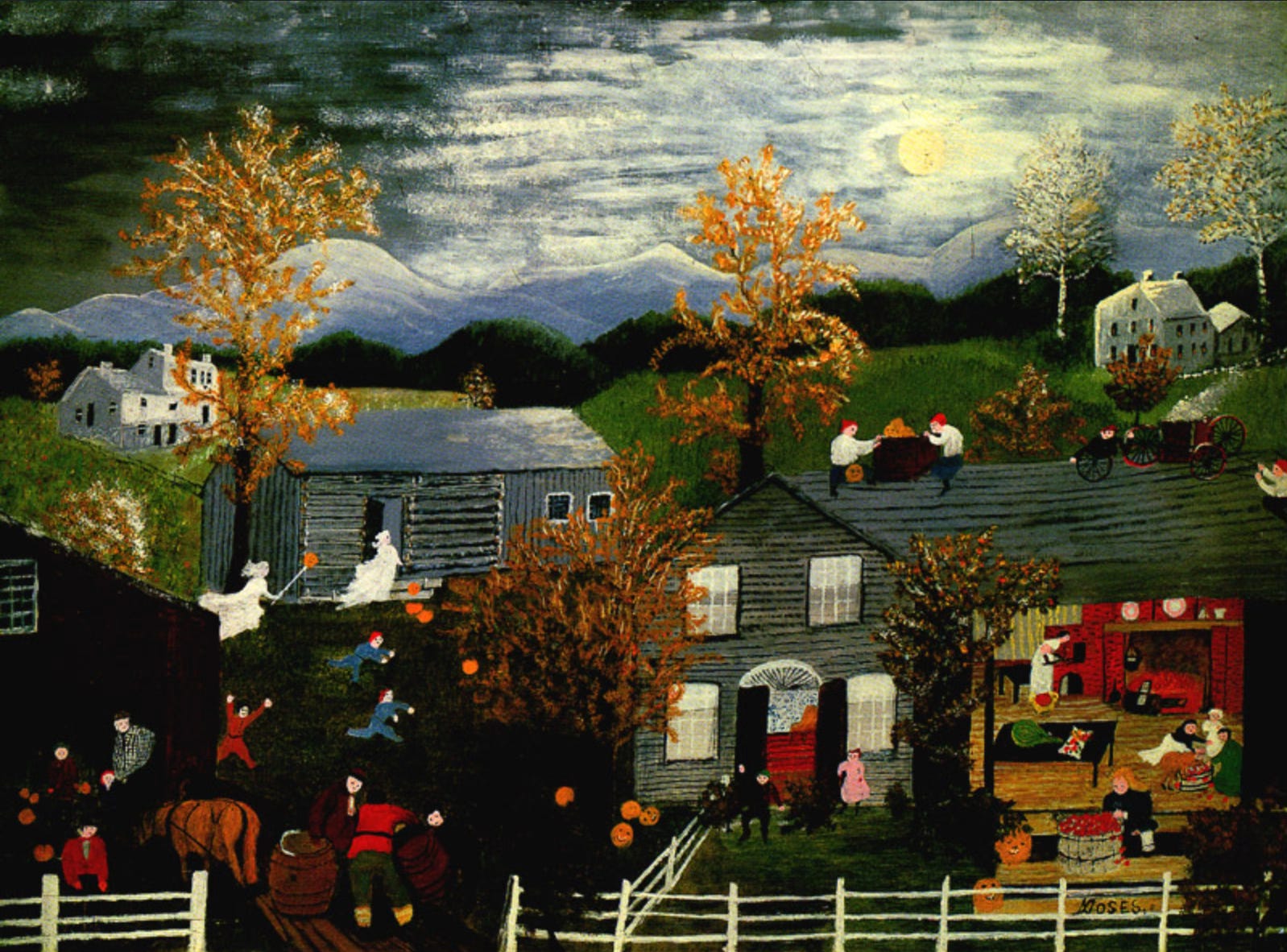
I’ve long enjoyed Halloween (even though I’m a bonafide hesitant adult dresser-upper, for whatever reason). I love the autumnal air; in Central Texas this is the time of year it finally, legitimately feels like fall. I love the neighborliness of it all, of walking up and down our streets—especially the one uber-popular one in our historic neighborhood where the people go all-out and the police put up barricades to block the cars (my youngest son also knows where to hit up for the full-size candy bars). I love the low expectations of Halloween (except for the dressing up bit, which is perhaps why I don’t really go for that part)—there’s no traditional banquet to make, no gift-giving (other than candy to cute kids), and no major family visiting. The day just seems to bring out the good, old-fashioned revelry among the good-hearted neighbors among us. It’s a good, good day.
Most of my childhood was spent in the 80s, the era of checking for razor blades in candy and the heyday of Satanic Panic. Even though I grew up in a Christian household, my parents gratefully didn’t shun the holiday (even though it was downplayed). Yet over the years, as I moved into early adulthood, I felt conflicted about the day: how does one celebrate it as a Christian? Does one celebrate it at all?
I could do the Reformation Day thing, but even when I was an evangelical, that always felt a bit ridiculous (and now I see it as a downright sad thing to observe: the moment in Church history when we fractured into a bajillion pieces?). Nope, that wasn’t for me. Instead, I simply leaned into the fall-ness of the holiday and kept the spirits at bay: pumpkins, colored leaves (fake, of course—hi, Texas), pretty candles, and the like. Visiting pumpkin patches on local farms with hayrides and corn mazes.
All great things. Sometimes I wish my kids were still young enough for me to glean the excuse to go to a farm’s fall festival without looking like a grown-up weirdo. But… Halloween? Yea or nay?
Fast-forward to today, when my youngest has to work Halloween night, my middle guy is off at college and I have no idea what shenanigans he’ll be up to, and my oldest is married and can legitimately no longer justify asking strangers for candy. I’ve now been Catholic for nearly six years. And I love Halloween more than ever. Why? Because I’m a history nerd. And because it’s one day out of a trifecta season delightfully called Hallowtide.
A (Very) Brief History of Halloween 👻
Christians have honored martyrs from very early on; we have record of communal feasting days set aside to do so by the late 4th century.1 All Saints Day was officially started in 609, when Pope Boniface dedicated one feast day to formally honor all martyrs. It was then eventually moved to November 1, first mentioned as a feast for all saints during the reign of Pope Gregory III (731-741), who fixed it as a date to recognize all the apostles, martyrs, confessors, and the just. A century later, Pope Gregory IV (827-844) extended the feast day to recognize all saints of the whole Church, especially those unnamed.2
Halloween is the vigil of All Saints Day, similar to Christmas Eve, and “Halloween” is simply a contraction of All Hallows’ Eve (“hallows” means ‘holy ones’). It always falls on October 31 because it’s the vigil of All Saints, which always falls on November 1. Add All Souls Day the next day on November 2 (more on this below), and we get the three-day feast of Hallowtide.
Nearly all the customs of modern secular Halloween developed in the past 500 years, with almost no ties to ancient pagan religion. Several grew from some medieval Christian practices—as historian Beth Allison Barr puts it, most Halloween traditions are medieval or early modern in origin, not pagan.
My favorite internet Halloween enjoyer is Joe Heschmeyer, and I appreciated one of his podcast episodes from a few years ago, where he unpacked why Halloween isn’t a ‘baptized’ Samhain, as some like to declare:
Memento Mori 💀
All of Hallowtide is actually an excellent season to reflect on death—in all the right ways and in a healthy manner. This is because after All Hallows’ Eve and All Saints Day, we roll into All Souls Day on November 2. This is a day set aside for Christians to remember and (yep) pray for believers who have died, especially our loved ones.
All Souls’ Day tends to be a little more personal: it’s for the grandparents, other family members, and friends who’ve died trusting Christ but, like all of us, died still imperfect. The day rests on the Christian hope that death doesn’t break the bond between members of Christ’s body, and that we’re surrounded by “so great a cloud of witnesses.”3 It’s a chance to remember our loved ones by name and hold onto the hope of the resurrection we share with them.
Note: I get more into how I came to understand the concept of Purgatory, how it’s a condition of purification and not a place, and how it’s actually a loving, beautiful gift to us—and how nearly all Christians throughout Church history understood this idea as part of our readiness to stand face-to-face with Jesus—in my forthcoming book about why on earth I became Catholic, which will release next spring 2027.4
Here are a few reasons why Hallowtide is a beautiful season to reflect on earthly life, our inevitable death, and our hope for heaven:
1. It holds death and hope together. Hallowtide moves in three steps: the eve most are familiar with, then the saints in glory, and then the souls being purified to see the face of God. We remember that death happens within a grace-filled story, thanks to Christ’s resurrection, which points to hope, not morbidity.
2. It’s communal. Memento mori as an idea and practice can turn anxious when practiced alone, but during Hallowtide, the whole Church remembers together, and the communion of saints reminds us that the dead are part of the great family alongside us.
3. The natural season preaches. Falling leaves, shorter days, and the end of harvests make mortality better understood, not morbid. Nature and liturgy speak to us in harmony.
5. It lets us laugh at death. Costumes, skeletons, and jack-o’-lanterns at their best are a Christian taunt. As Paul asks, “O death, where is thy sting?”5 we can mock what has been defeated.
6. It leads us beautifully toward Advent. The end of the Church’s liturgical year turns our attention to what we’re meant to remember during Advent—namely, the Last Things: death, judgment, heaven, and hell. Hallowtide begins this reflection, then Advent continues it as we wait for Christ’s coming.
7. Therefore, it helps us reorder our priorities before the holidays. Remembering that life is short in early November is a good guard against the temptation toward an unfocused December, especially when we spend that time both remembering our deceased loved ones and expressing daily gratitude leading up to Thanksgiving.
Joe Heschmeyer also explains well why Hallowtide is a good time to reflect on death—in all the right ways:
So how will I celebrate the trifecta of Hallowtide this year? Firm plans are still TBD, but I’m thinking we may enjoy an early dinner and neighborhood stroll to enjoy the creative costumes and adorable children (because so many flood the few streets that go all-out, we actually don’t get many trick-or-treaters to our home), then the next day go to church and celebrate All Saints with our parish family, followed by an All Saints’ party at our friends’ house—and perhaps reflect that evening on the sheer awesomeness of my confirmation saint, St. Monica6. Then on All Souls Day the following day, celebrate Mass and pray for our loved ones (our grandparents come to mind). Then that evening, the two of us will probably feast on a lovely steak dinner—because on that day we’ll celebrate 24 happy years of marriage.
Don’t be fearful of Hallowtide. Claim it as your legitimate spiritual heritage. It’s a beautiful season.
For a bit more:
Halloween Revisited (a staunchly Protestant journal)
The Stations of the Sun: A History of the Ritual Year in Britain, by Ronald Hutton
5 Ironies of Reformation Day, with Joe Heschmeyer
Baptist Hell Houses, Catholic Halloween, with three fellow Catholic converts
St. Ephrem the Syrian in particular mentioned this in one of his sermons in 373.
Hebrews 12:1.
And heads up: C.S. Lewis agreed with the doctrine of Purgatory, too: “Our souls demand purgatory, don’t they?” he mused in Letters to Malcolm: Chiefly on Prayer.
1 Corinthians 15:55.
And some other of my favorites: St. Augustine, St. John Henry Newman, St. Francis de Sales, St. Philip Neri, Sts. Louis and Zelie Martin, and plenty more.
Thank you. I am looking forward to your book next Spring!