


Like last year, I’ve found another short story for the holidays in my fictional town of Quincy, Texas. It’s a bit quirkier, this one, but this town is strange so it kinda checks out (also see here, here, and here).
It’s also below as a printable download, if you prefer to read on good old-fashioned paper (my preferred delivery for all fiction these days).
Enjoy, and Merry Christmas! I’ll be back around here in the new year.
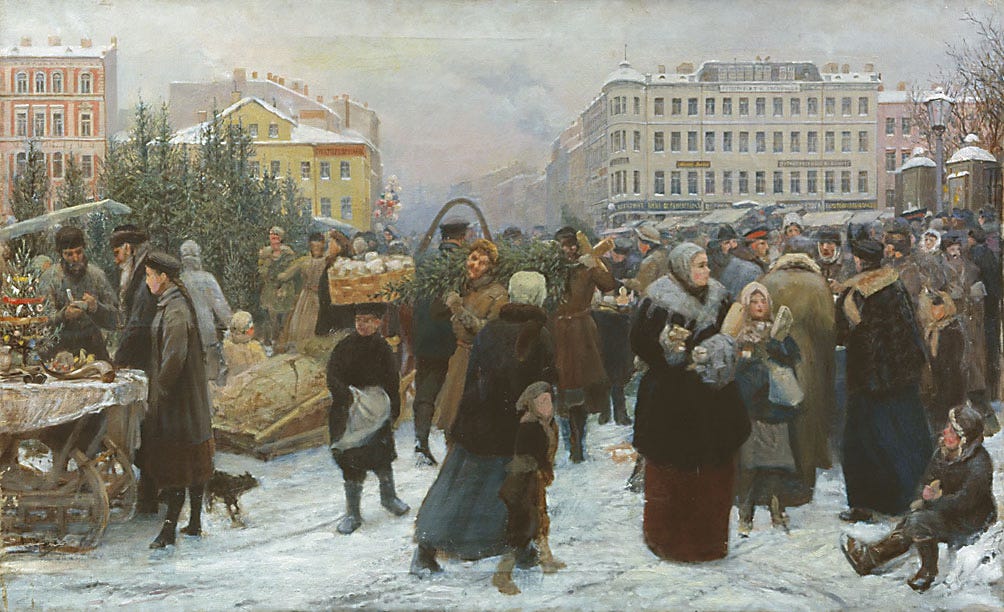

If you’ve ever been to Quincy, Texas, you know the town Square tries its very best during the holidays, but the decades-old tinsel still sags, the lights flicker, and the fiberglass nativity on the courthouse lawn wobbles whenever the north wind sneezes. Harold, the geriatric algebra teacher, still proudly serves as the Santa on horseback in the grand finale of the parade, and the high school’s marching band still kicks off said parade with a rendition of “Sleigh Bells” so out of tune that, two decades later, a website eventually known as YouTube will make its good-hearted, well-intentioned annual performance go viral. Quincy’s imperfections are proudly displayed as though its citizens don’t even know its shortcomings are, in fact, a shabby facsimile of the closest big city’s downtown window displays.
McIntyre’s Mercantile sits on the westside corner of the Square, as it has since Teddy Roosevelt was said to have passed through on a hunting trip. Opinions vary on whether he actually entered the store or merely winked in its direction from his horse, but that didn’t stop the mercantile from hanging a plaque on the wall saying as much.
This story begins here, reader, but before we proceed you must understand that Clementine Jones is a perfectly normal young lady, yet her family’s long-held mercantile on the westside corner of the Square is decidedly not. Reasons why will be revealed to you should you one day read Clementine’s full-length adventures, but for now, simply know that she has recently discovered her family’s mercantile’s secret, and you, unfortunately, have not.
Clementine smelled faintly of cinnamon and Windex, like she usually does this time of year. Two days ago she trimmed her bangs too short and still couldn’t stop fidgeting with them, and to her great annoyance, this morning she chose the pair of socks with a hole in one of the big toes. Her green apron was on inside-out, but so far no customer has had the heart to tell her (she will find out at closing time). This was good, because it was Christmas Eve and she had bigger problems than a bad homemade haircut and an apron with the store’s name monogrammed on the inside.
Bianca’s Maria’s tamales were officially missing.
Since you are a reader from out of town, you are unaware of the magnitude of this disaster. In Quincy, Maria’s Christmas tamales are not merely food; they are tradition, diplomacy, and spiritual sustenance. Whether you chose pork, chicken, or green chili, as you took your first bite you’d praise God for old women who cooked and question your secret agnostic proclivities. Even the Presbyterians bought them and simply removed the Lady of Guadalupe sticker on the foil before setting them out on the kitchen island. Losing tamales on Christmas Eve like Clementine had just done would make the Quincy Clarion’s front page.
Clementine stood in the back aisle, hands on hips, and stared at the empty warmer where 48 foil-wrapped dozen-packs should be. They were there an hour ago, where she placed them and then promptly and proudly hugged Bianca. Clementine remembered burning her pinky as it accidentally brushed the heating coil when she placed them all in the warmer; Bianca was telling her how she almost ran out of cumin but found some in the back of her spice cabinet at the last hour.
The bell on the front door jingled. Clementine closed her eyes. Folks would start coming for their tamales as they headed home from their church’s Christmas Eve services. St. Anthony’s first Mass was at 4:00, but it was only ten after right now. At this point, most customers popped in only for last-minute ingredients or for a hit of Fran’s apple cider (a quarter per cup; get your own from the thermos and leave coins in the coffee can). She quickly prayed the jingle was for the latter.
“Buongiorno, Clementina!”
She opened her eyes, briefly sighed in relief, then stepped out from the aisle. “Marco,” she said, trying for casual. “You’re late.”
“Late? No, no. I am perfectly on time,” he beamed, setting a crate of tins embossed with snowflakes on the front counter next to the register. “For your store.”
She blinked, still deciphering his words thick with his accent. “What?”
“For your store.”
“No, I understood you,” she said, “What do you mean ‘for the store’?”
He tapped on the tins. “Christmas gift from my family.”
Clementine brushed her hands on her apron and walked up to the front, failing at hiding a smile which resulted in the unfortunate look of a twitchy half-frown.
He tousled her hair, then picked up a smattering of bangs. “Oh dear, what happened?”
“Don’t worry about it.” She pulled her head back, then removed one of the tin’s lids to breathe in the aroma of a golden-brown crusted dome hatched with an X and brushed with the sheen of egg white and sugar syrup. Candied citron and butter wafted through the air between them.
Marco tapped on the bread dome and said, “My nonna says hello.”
“Hello to Nonna.” She smiled with burning pink cheeks as he deftly moved his right leg behind him, just a smidge, but enough to reveal he was also hiding something at his feet. Clem furrowed her brow and tilted her head as she leaned to the left—a brown canvas duffel bag on the floor behind him.
She narrowed her eyes. “Marco…”
“Yes?”
“Have you seen Bianca’s Maria’s tamales?”
He froze. Then, “I have… heard of tamales. Like enchiladas, yes?”
“No.” Clementine crossed her arms. “Where were you an hour ago?”
“An hour ago? I was…” he gestured vaguely. “Traveling.”
“Oh gravy… This is why you were late,” she replied, panic catching in her throat.
To catch you up, reader, on the even-deeper reason behind Clementine’s panic: Maria died earlier this past spring. At 92 years old it was not a surprise; in fact, the entire town wondered how she managed to hold on for so long, but folks willed her to live because they could not imagine Christmas Eve without her tamales. It had long been the plan for her great-granddaughter, Bianca, to take over the tradition once the inevitable occurred, Maria finally bequeathing her secret recipe to a newer branch in the family tree.
“Clem …they’re not very good,” Bianca confessed in a whisper earlier that morning when she had dropped them off.
“Nonsense. I bet they’re great,” her former classmate replied. Clementine remembered a brief conversation they had as lab partners in biology class eight years ago when Bianca admitted she accepted her town fate as Tamale Queen somewhat begrudgingly.
“They’re really not. She gave me her recipe, but I just couldn’t get the hang of them. Not sure why.”
“Well... If you’re right, then maybe it’ll be time for Quincy to find a new tradition,” Clementine shrugged.
Bianca groaned, leaned over, and tapped her head in mock defeat on the wood counter by the register. “Great. Everyone will love me. I’ll be forever known as Bianca, Destroyer of Tamales and Anything Still Worth Anything in Quincy.”
Clementine turned around and glanced at the open, now-empty warming bin. The tamales had, indeed, been there earlier this morning. Marco shifted his crate of pannetone a few inches closer so that Clementine could see them at a different angle.
“These tins are kept by the people in my village. Once they eat the pannetone they store sewing supplies and plant herbs in them for their balconies,” he said with too much enthusiasm.
She furrowed her brow. “Marco,” she said, “...What’s that?”
“What is what?”
She pointed at the bag at his feet. “That.”
“Nothing.”
The front bell chimed and two middle-aged women walked in, city folk she didn’t recognize. “Apple cider?” said one.
“Yes ma’am,” said Clementine, “Right over there. Help yourselves.” The pair turned toward the carafe and coffee tin.
She turned back to Marco, who had now scurried over to the tamale warmer.
“Hey!” Clem said and dashed over. He was now holding the duffel bag in front of him in futile attempt to hide it. “What is THAT,” she said, pointing.
Marco sighed. “Do not be mad, amici,” he said, “I am only here to help.”
“With what?”
“Well...” he said, pausing. Then, “I remembered your friend Bianca, and how you said she was worried she would not make good tamales this year. So, I looked up tamales in a cook book on my grandmother’s shelf; she got it many years ago in Mexico. ...Bianca is right,” he pointed at the bag’s contents, “These were not good.”
“What did you do?” Clem whispered, eyes wide.
Marco shrugged. “I made them better.”
She held her breath. “Um...Marco. People are picking them up now. This afternoon. They do not want change. They want their Christmas Eve tradition.”
He shrugged again. “They will like this better, I promise. They really were no good.” Marco unzipped the duffel and revealed stacks upon stacks of foil-wrapped cylinders, held together by twine in groups of twelve. He pulled out a rogue one on its own, unfurled the foil, and revealed a masa-covered tamale with a sugared sheen and dotted with a row of dried fruit.
Clem gasped. “Oh no.”
“What? They are good now.”
“How can these possibly be good? What is that?”
He shrugged again. “After I made the pannetone, I took the glaze that was left and drizzled it on top, then added leftover dried fruit on top.”
Her jaw dropped. “Marco. That sounds horrible.”
“Hey now, amici. Do not think so until you’ve tried one.”
He took a bite, chewed a few seconds, then grunted. “Si,” he said, “Very good.”
Clementine took the tamale from his hands, held it to her mouth, paused for a second with a grimace, then took a small bite. She let it linger in her mouth for a moment, then chewed slowly and swallowed.
“Well? Am I right?”
She dropped her shoulders in confusion and took another nibble. She handed it back to him and looked up at him with befuddlement. “…Why is this good?”
He laughed. “It is, no? See, I am right.”
“But this shouldn’t be good.”
“I know,” he shrugged again, “But it is.”
“Marco, tamales are corn meal, meat, and spices. Pannetone is... Well, not that. Sugar. Fruit. Bread.”
“Si, I know,” Marco said, taking a bite of his creation from her hands. “Nonna did not believe me either, but she took a bite too and now loves them.”
“Wow… I’m surprised she approves.”
“That means something, as you know,” he said. Clem nodded. “She highly disapproves of things like this. Breaks from tradition.”
Clementine took another bite, bigger this time. The taste of glazed sugar, candied lemon, and pulled pork encased in masa swirled in her mouth in a combination that should have been, by all accounts, unholy. But it was divine.
“Marco,” she said, mouth full, “When did you do this?”
“I did not steal,” he protested. “I only borrowed.”
“Okay,” she hesitated, “But when?”
He tilted his head and said in a lower voice, “I came this morning to help you in your Christmas rush—see, I was on time, but then I overheard what Bianca said. I had just finished making the pannetone at the bakery and knew no one was there in the back, so I thought I’d take them over quickly to …dress them up.”
Clem gasped. “At your …family’s bakery?” He nodded.
(Reader, once more, you will understand the gravity of his valiance once you dive deeply into Clementine’s full adventures.)
She exhaled and closed her eyes. She didn’t bother pressing him. His answers to questions like these always hovered between improbable and impossible, and she knew he wouldn’t clarify even if she tried. “Okay. I’m grateful for your good intentions. Just …Will you please talk to people as they come for their orders? So you can explain? It will come much better from a total stranger.”
“Of course. They will love their new Italian tradition.” Clementine doubted this with every fiber in the deepest recesses of her heart.
The two stacked the tamales back in the warmer, then Marco brought back the crate of pannetone and displayed them in a pyramid-like stack on the table to the right. The scent of piping-hot tamales encrusted with sugar and citrus would horrify any professional food critic. But the aroma was, indeed, peculiarly and mysteriously succulent.
When they finished, Clementine brushed her hands on her jeans and walked to the register. “You owe Bianca an apology.”
“Or a ‘you’re welcome’,” he said slyly. She smacked his arm. “Fine—I will make her a cake,” Marco offered. “Pistachio. With rosewater glaze.”
“She doesn’t like pistachio. Or rosewater glaze, probably.”
He blinked. “Who does not like pistachio?”
“Bianca.”
He exhaled. “Then I will offer tamales.”
“That absolutely would not help.”
The front door bell jingled, and Jenny Cartwright swept in wearing a red sweater embroidered with blinking lights.
“Morning, Clem!” she hollered. “I’m here for my order. Bert’s been talkin’ about ’em all day.”
And thus begins the inevitable, Clementine thought as she opened the warmer, grabbed Mrs. Cartwright’s order, and handed them over.
“Bless you,” Jenny said, flapping her free hand at Marco. “And who’s this stranger?”
“This is Marco,” Clementine said. “He’s… visiting.”
“Where from?”
Clementine, sensing Marco was about to answer, interrupted with a quick, “—Oh, just from out of town.”
“I am Italian,” Marco offered.
Mrs. Cartwright raised her eyebrows. “Well now, then. I hope Quincy’s treating you right. …What’s that smell?”
“Your tamales,” Clem said too quickly again. “Marco …helped with them this year.”
“Well,” Jenny replied, then glanced in the bag, “As long as they’re still Maria’s tamales. Bert would have a conniption fit.”
“They are better, amici,” Marco chimed in, “They have an Italian —sweetness.”
She furrowed her brow. “Hmm.”
Mrs. Cartwright left as a skeptic as Mr. Sanchez arrived next to pick up his order, who left in polite silence but could tell something was different. Then the Ramirez twins. Then Clarence Pruitt from the gas station, who noticed the pyramid of tins.
“What are those?” he asked loudly, as was his custom.
“Pannetone,” Marco answered with pride, “An Italian tradition for Christmas. My family makes them.”
“Italian, you say?”
“Want one?” asked Marco.
Clarence’s eyes lit up. “I s’pose if it’d make Gwen think I was fancy,” he wondered out loud.
“Oh yes,” Marco replied, “Very fancy. And, they go beautifully with your tamales. She will love them both.”
“Really? Huh. …Alright then, I’ll give ‘em a whirl.” He walked out the mercantile proudly holding a bag of tamales in one hand and a tin of pannetone in the other.
When the early rush passed, Clementine and Marco looked at each other.
“It’s going just fine so far, amici,” Marco said.
“Sure, but we’ll see what people say once they take a bite.”
“You think too lowly of your fellow townspeople,” Marco said.
She scoffed. “It’s not that. Quincy’s just …not known a lot of change, that’s all.”
He winked. “Yet.”
The bell jingled again. In walked Mirabelle McIntyre, donning her daily walking outfit and faintly out of breath.
“Hello, my dear,” she called out as the door closed behind her, then did a double-take in Marco’s direction. “Oh —hello. Are you a friend of Clem’s?” she held out her hand.
“Yes ma’am,” Marco answered in his lilted accent as he shook her hand, “We are friends. I am from out of town.”
“I should hope so; I know everyone here,” Mirabelle answered. “Where are you from? Definitely not from around here.”
Marco tilted his head in wonder at her own accent. “I am Italian. …And you?”
“French. I’m Clementine’s grandmother.”
He smiled. “Ah yes! She has told me much about you and your husband. Very, very nice to meet you then.” He leaned in to kiss her cheek.
“Oh!” she said with surprise, “You’re as friendly as a Texan.”
He shrugged. “Italian.”
She looked at her granddaughter with narrowed eyes. “…How did you two meet?”
“Oh,” Marco replied, glancing at Clementine, “Just around.”
Mirabelle furrowed her brow and shifted her eyes back and forth with skepticism at the two of them. “…Hmm, okay,” she eventually said with a nod. “Well, you must stay with us for Christmas, if you like.”
He glimpsed at Clementine, who subtly shrugged her shoulders. “Yes. You …should.”
“I, uh… I,” Marco stammered, “Maybe so. Thank you.”
“Mémé, did Grandpa need anything?” Clementine asked, changing the subject.
“No, I came in for some post-walk cider. He’s just resting at home.”
“I’ll get you some!” Clem answered too enthusiastically. She walked to the cider station and grabbed a cup.
Mirabelle turned to Marco. “So you’re the baker boy,” she said quietly.
“Yes, ma’am.”
She leaned in. “Do not dare crush the heart of my granddaughter. I know Italian men. …But also,” she nudged him, “She cannot stop talking about you.”
“We are just friends, ma’am.”
“Yes, she says the same thing.”
The afternoon continued in a rhythmic liturgy of customers coming and going, the stack of tamales slowly decreasing, the scent of cumin and sugar lingering. Clem checked names off the order list and ran the register while Marco handed out tamales, offering sliced samples of panettone in tandem that people initially accepted with polite suspicion, then eager delight. Tins soon departed as quickly as the tamales.
As the dipped sun eventually began turning the windowpanes orange, Jenny Cartwright burst through the door, bells jingling with a fury.
“Hey Italian boy!” she shouted.
“Marco,” Clementine reminded her, her heart stopping, “…Is there a problem, Mrs. Cartwright?”
Marco wiped his hands on his apron and sauntered to the front with a confident smile. “Yes, ma’am?”
“MARCO,” Jenny said with such force it was indecipherable whether the tone was anger or delight. “…What did you DO? Bert has eaten so many tamales we ran out already.”
He clapped his hands with enthusiasm. “Ah yes, I knew it! I am so delighted to hear!” He offered Clementine an ‘I told you so’ nod.
“Really?” Clem asked, “Are you sure he likes them?”
Jenny chortled. “Am I sure? Honey, he won’t shut up about them. He’s on the neighbor’s porch telling ‘em about them right now.”
“Tell him they are the new-and-improved version of Maria’s tamales. He won’t even miss the old ones,” he replied.
She left as quickly as she burst in as Marco bumped Clementine’s side. “See, amici? I told you so.”
She exhaled. “Well, that’s one down… We’ll see what the rest say. Bert’s review is a good sign, though; he’s one of Maria’s longtime acolytes.”
“Everyone will love them, I promise.”
“Mr. Sanchez is an old friend of Ms. Maria; you may have trouble winning him over.”
“Well, if it helps, all the tamales are gone and we just sold the last of the pannetone,” he offered with pride.
“That actually does help,” she answered with a sliver of relief. “You know,” she said lightly, “Seems you’re becoming a bit of a local celebrity.”
“Is that good?”
“Depends on what Bianca says. And whether you’re up for doing this again next year.”
Marco glanced at her, eyes hopeful. “Clementina?”
“Yes?”
“I can do this next year. And the year after.”
Her cheeks warmed bright pink and a familiar rumble hummed under the old wood floorboards beneath their feet as they relished a shared silence for a few seconds. Then, “Clementina?” Marco asked, breaking the quiet.
“Yes?”
“My family does not know I’m here and I will soon need to hand out our pannetone orders.”
Clem checked her watch and nodded. “You’re right. It’s fine; you need to go. Thank you so much for the help. You were a lifesaver, I admit it.”
The door jingled again and in walked Mr. Sanchez.
“Clementine,” he said with his elderly voice of authority, “What did Bianca do?”
She grimmaced. “...What do you mean?”
“She changed Maria’s recipe,” he said gruffly, “And Maria’s recipe was just fine. More than fine. Why did she do that?”
She opened her mouth to answer as Marco interrupted, “—Perhaps she thought the town needed a change.”
Mr. Sanchez raised his eyebrows. “Change? We had enough change, what with Maria’s passing in the first place.”
“Well then,” he countered, “Perhaps she wanted to give an homage to her great-grandmother by letting her old recipe stay with her. To say, ‘No one can make tamales like you so we won’t even try.’”
Clementine and Marco allowed the silence to linger in hopes the offered explanation might be considered.
“Hmm,” Mr. Sanchez grumbled, “She was the best. I suppose this is a sign she cannot be outdone.” With that, he left and continued down the sidewalk to his parked truck.
Marco turned to her. “See, you survived that. The town will be okay.”
She gave a half-hearted smile and nodded. “I guess.”
He picked up his empty duffle bag. “Tell your grandmother thank you for the offer to stay, but that I needed to suddenly go home.”
“That’ll be kinda strange, won’t it?.”
“Hmm…” Marco nodded. “Okay, tell her I had to visit an old friend in town.”
She scoffed. “She will never believe that.”
“This is probably true,” he admitted, “But Clementina, I don’t know the right thing to say. Do you?”
She shook her head. “I got nothing.”
“Hey…Would you like to come with me? Right now? You can help me with my Christmas orders.”
“I mean…” she sighed, “I’d like to. But… Wouldn’t it be strange for me to leave? On Christmas Eve?”
He shrugged and sighed. “Oh bene. …We will—how you say,” he paused. Then, “Cross all of these bridges when they come.”
She nodded. “I suppose you’re right.”
“For tonight though, your grandparents will be asleep and won’t even know.” He glanced at the clock above the door. “It is time to close, no?”
“It is. Let’s clean up and get outta here,” she said, unlooping the apron over the head. “…Dangitall, Marco, how come you didn’t tell me this was on backwards this whole time?”
“Don’t worry, amici, no one has noticed because of your haircut.” She slugged him.
He swept as she closed out the register, and as the windows morphed from deep orange to the twinkling blue of a Texas winter evening, Clementine locked the front door, turned the sign on the glass to ‘closed’, and added a taped handwritten note facing out: Bianca—call me. I can explain.
“Well?” Marco said when they finished, reaching out his hand, “Are you ready?”
Clementine nodded and placed her hand in his. “I guess. I just hope Grandpa and Mémé don’t notice I’m not at Midnight Mass.”
“Just tell them you came to mine,” he said, and as they walked the floorboards rumbled once more. Outside, the wind gushed and the fiberglass Joseph fell over on the courthouse lawn.